

Targeted Solutions: The Most Effective Aiptasia Treatment Products
There is something uniquely frustrating about Aiptasia in a reef aquarium.
It rarely shows up with drama. It starts with a single translucent pest anemone tucked between coral frags or emerging from a shadowy gap in the rockwork. A beginner may barely notice it. A seasoned reef keeper notices it instantly — and knows it can become a serious problem if ignored.
That is because Aiptasia rarely stays as “just one.”
It can sting neighboring corals, spread into inaccessible areas, and turn a clean aquascape into a constant source of irritation. While biological controls such as peppermint shrimp and Berghia nudibranchs can be highly effective, there are many situations where reef keepers want a faster, more direct solution.
That is where Aiptasia treatment products come in.
For many hobbyists, targeted treatments are the quickest way to take immediate action, especially when the outbreak is still manageable. Done properly, they can eliminate visible pests before they spread further. Done poorly, they can make the problem worse.
The key is not just having the right product. The key is understanding how to treat Aiptasia without triggering fragmentation, re-seeding the tank, or stressing nearby corals.
Why Direct Treatment Is So Popular
Aiptasia treatment products remain popular for one very simple reason: they give the aquarist a sense of control.
Instead of waiting days or weeks for a livestock-based solution to make progress, direct treatment allows you to:
- target visible Aiptasia immediately
- reduce the infestation before it spreads
- focus on problem areas near prized corals
- deal with outbreaks in tanks where biological control is less practical
For a novice reefer, that immediate action is reassuring. For an experienced aquarist, it is a useful tool in a broader management strategy.
It is especially effective when the infestation is still in the early to moderate stage, where individual Aiptasia can still be located and treated one by one.
How Aiptasia Treatment Products Work
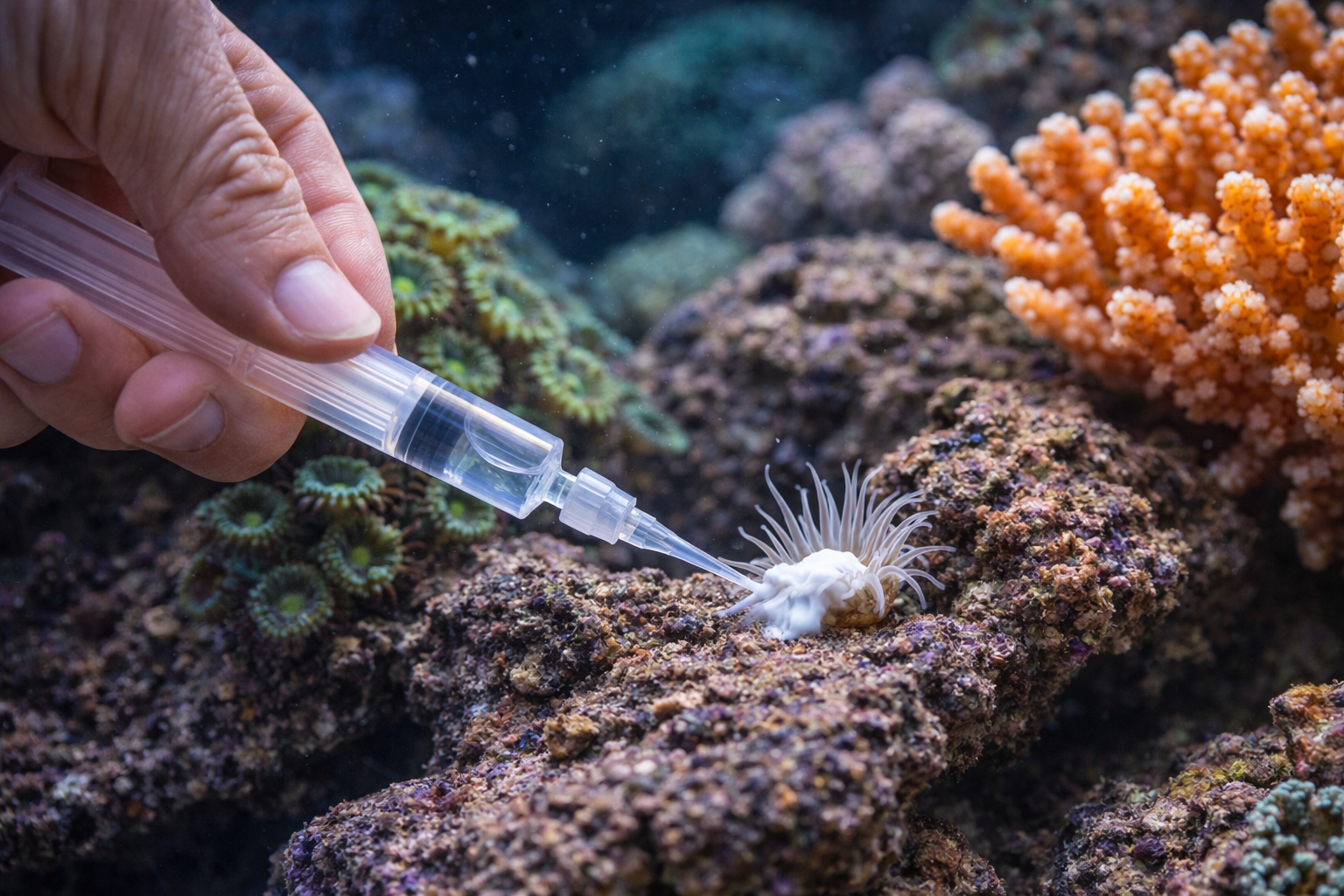
Most reef-safe Aiptasia products are designed to be applied directly onto or into the pest anemone.
While different products work a little differently, the basic goal is the same:
- coat or inject the oral disk and tentacles
- cause the Aiptasia to ingest or absorb the treatment
- prevent it from retracting and recovering
- eliminate the individual anemone before it can reproduce further
The best products are thick enough to stay in place and effective enough to neutralize the pest quickly.
This matters because Aiptasia is not just hardy — it is reactive. When disturbed, it can retract deep into the rock before treatment can take effect. That is why technique matters just as much as product choice.
When Product-Based Relief Makes the Most Sense
Direct treatment is often the best option when:
1. The infestation is still localized
If you only have a handful of Aiptasia, treating them early can prevent a much bigger problem later.
2. The pests are near expensive or sensitive corals
Aiptasia stings can quickly irritate LPS, zoas, soft corals, and even SPS colonies. Immediate treatment helps protect surrounding livestock.
3. The tank has fish or inverts that may interfere with biological control
Some reef tanks are not ideal for Berghia. Some peppermint shrimp may ignore larger Aiptasia. In those cases, direct treatment can be more predictable.
4. You want to combine methods
Many experienced hobbyists use treatment products for visible adults and livestock for ongoing cleanup.
That hybrid strategy often works extremely well.
Common Mistakes Reef Keepers Make
The mistake is not usually buying the wrong product.
The mistake is using the right product the wrong way.
Here are some of the most common issues:
Treating too aggressively
Jabbing, scraping, crushing, or blasting the Aiptasia before applying treatment can cause it to retract or fragment.
Applying treatment in heavy flow
If pumps are left running, the treatment may blow off the target and onto nearby corals.
Over-treating the tank at one time
Treating too many Aiptasia in one session can add unnecessary stress to the system, especially in smaller tanks.
Ignoring tiny regrowth
Aiptasia relief is rarely one-and-done. Small new individuals or missed tissue can reappear, so follow-up is important.
Best Practices for Applying Aiptasia Treatments
If you want better results, slow down and be methodical.
Step 1: Turn off flow temporarily
Shut off return pumps, wavemakers, and circulation pumps for the treatment window. This helps keep the product on the Aiptasia and reduces the risk of drifting onto nearby livestock.
Step 2: Approach slowly
Aiptasia reacts quickly to shadows and sudden movement. Bring the applicator in slowly and steadily.
Step 3: Cover the oral disk thoroughly
The goal is not to “poke and hope.” The goal is to get the treatment where it will be effective and keep it there.
Step 4: Let the product sit
Give the product time to work before restoring flow.
Step 5: Watch the area afterward
Some Aiptasia disappear completely after one treatment. Others may need a second pass later.
Treating Large vs. Small Aiptasia
Not all Aiptasia respond the same way.
Small Aiptasia
These are often easier to eliminate because they are exposed and less entrenched. But they are also easy to miss, which is why regular inspection matters.
Large Aiptasia
Larger individuals can be more stubborn and often live in holes, crevices, or deep folds in the rock. These may require especially careful application or repeated treatment.
In many tanks, the most effective strategy is to treat large visible specimens first and then use livestock or repeat inspections to catch the smaller ones.
What Experienced Reef Keepers Know
Veteran aquarists usually do not think in terms of “one miracle fix.”
They think in terms of layers of control.
That means:
- direct treatment for visible adults
- biological controls for hidden or emerging pests
- ongoing observation to prevent re-establishment
That layered approach is what turns short-term relief into long-term success.
Experienced reef keepers also know that Aiptasia tends to reveal weak points in husbandry routines. A tank with new frags coming in regularly, no inspection process, and no immediate response plan is much more likely to end up with recurring outbreaks.
Protecting Corals During Treatment
One of the biggest concerns with direct treatment is the safety of nearby coral.
That concern is valid.
Even reef-safe products should be used carefully. Avoid smothering coral tissue, letting treatment drift into fleshy LPS, or applying product where it may settle onto delicate polyps.
If the Aiptasia is growing right beside a prized coral colony, patience matters. Sometimes it is better to wait for the Aiptasia to extend fully in a calm period than to rush a treatment and risk collateral damage.
For beginners, this is where restraint helps. You do not need to attack every tiny suspect spot in a panic. Methodical treatment is more effective than rushed treatment.
Tanks Where Product-Based Treatment Really Shines
Direct treatment can be especially useful in:
- nano reefs
- mixed reefs with easy visual access
- frag systems
- tanks with only a few visible Aiptasia
- systems where biological control is likely to be eaten or ignored
For many J&L customers, these products are a practical, accessible first response. They are easy to understand, easy to apply with practice, and give the hobbyist a real chance to get ahead of the problem.
When Products Alone Are Not Enough
This is the part many hobbyists learn the hard way.
If your tank is heavily infested, direct treatment alone can become exhausting. You may eliminate one group only to discover more in the back, under ledges, or behind coral branches.
At that point, product-based control may still be part of the answer — but it usually works best alongside livestock relief.
That is often the sweet spot:
- use products to reduce the visible population fast
- use peppermint shrimp or Berghia to tackle hidden survivors
- maintain inspection and prevention habits afterward
This is where reef keeping moves from reaction to strategy.
Aiptasia Relief Is About Timing
The earlier you act, the easier the battle usually is.
That is true whether you are using livestock, products, or both.
A beginner may hesitate, hoping the pest will stay contained. An experienced reefer usually knows better. Aiptasia almost always rewards delay by becoming more difficult to eradicate later.
The good news is that modern reef hobbyists are no longer limited to crude removal methods that often make things worse. With the right Aiptasia treatment products and a calm, deliberate approach, you can take back control before the infestation becomes overwhelming.
Final Thoughts
Aiptasia treatment products are not just emergency tools. They are an important part of a smart reef keeper’s toolkit.
Used properly, they can:
- stop isolated outbreaks quickly
- protect nearby corals
- reduce visible pests before livestock takes over
- become part of a complete long-term control strategy
For some tanks, they are the primary solution. For others, they are the fast-acting first step in a broader plan.
Either way, the lesson is the same: direct treatment works best when it is precise, patient, and paired with good observation.
In the final part of this series, we move beyond elimination and into prevention — because removing Aiptasia is only half the battle.
Keeping it from coming back is where real reef-keeping discipline begins.


