

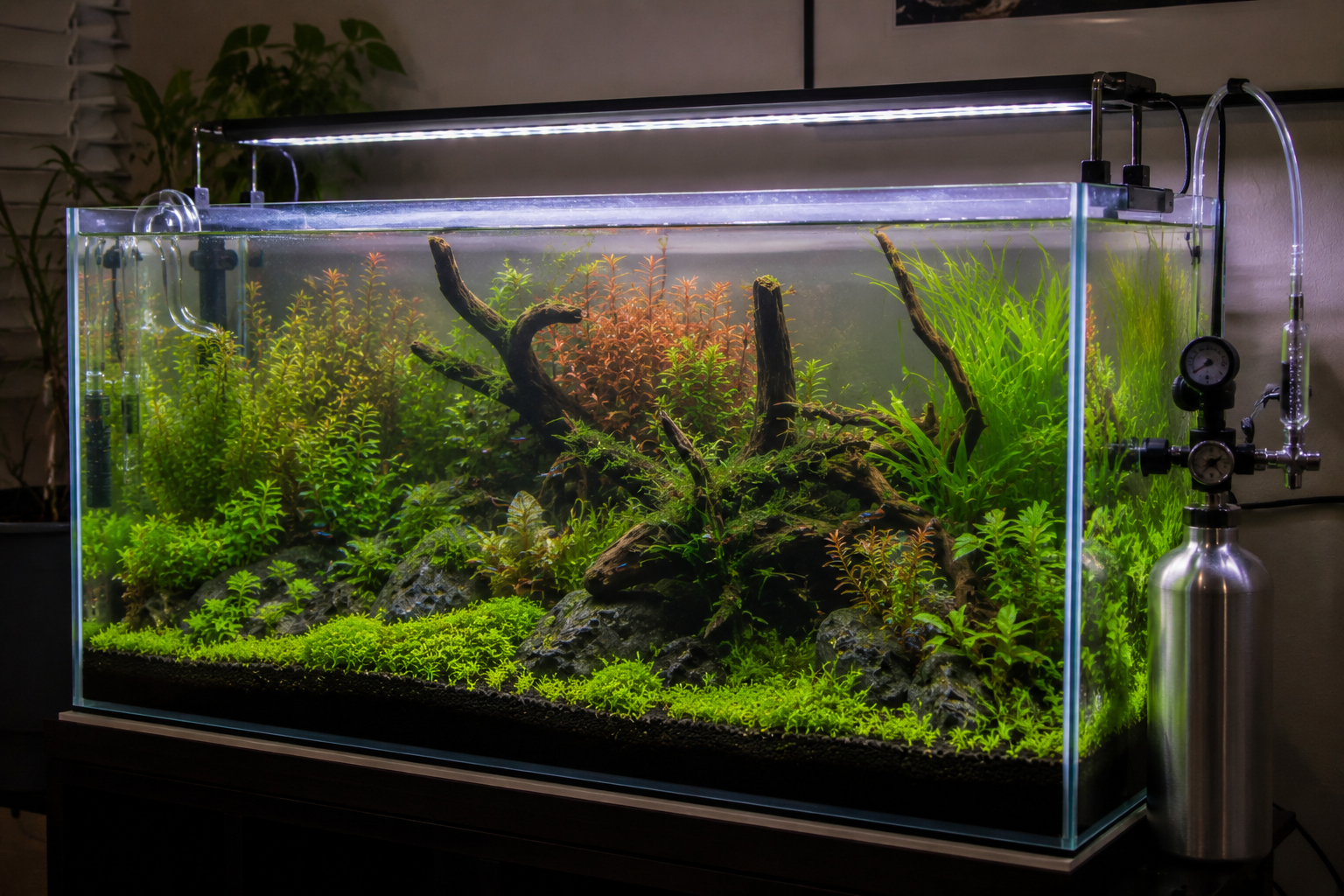
A planted aquarium combines fishkeeping, aquascaping, and plant care into one living ecosystem. A well-maintained planted tank can feel calm, natural, and incredibly rewarding. The movement of fish through healthy greenery creates a completely different atmosphere than a traditional aquarium.
But planted aquariums are also about balance. Unlike standard freshwater tanks, plants introduce additional variables such as lighting intensity, nutrient availability, substrate quality, and carbon dioxide levels. When one area becomes unbalanced, algae often appears quickly.
The good news is that planted tanks do not need to be overly complicated. Whether you are starting your first planted aquarium or refining a high-tech aquascape, understanding the core parameters will help create a healthier and more stable system.
Core Parameters for a Planted Aquarium
| Parameter | Recommended Range |
|---|---|
| Temperature | 72–78°F (22–26°C) |
| pH | 6.5–7.5 |
| Ammonia | 0 ppm |
| Nitrite | 0 ppm |
| Nitrate | 10–20 ppm |
| Phosphate | 0.5–2 ppm |
| CO2 | 20–30 ppm (high-tech systems) |
Understanding the Balance of a Planted Tank
A planted aquarium depends on balance between three major factors:
- Lighting
- Nutrients
- Carbon dioxide (CO2)
When these three areas are balanced, plants grow well and algae remains manageable. When one becomes excessive or deficient, problems usually appear.
For example, strong lighting without enough nutrients or CO2 often leads to algae. Excess nutrients without plant growth can also fuel algae outbreaks.
The goal is not perfection—it is consistency and balance.
Lighting: Fuel for Plant Growth
Lighting is one of the most important components of a planted aquarium. Plants use light for photosynthesis, which drives growth and nutrient uptake.
Modern planted tanks typically use LED lighting systems because they are energy efficient, customizable, and capable of supporting a wide range of plant species.
Most planted tanks run lights between 6 and 8 hours per day. Longer photoperiods often increase algae risk, especially in newer setups.
Beginners are usually best starting with moderate lighting and easier plant species. High-intensity lighting can produce impressive growth, but it also increases demand for nutrients and CO2.
CO2: The Growth Accelerator
Carbon dioxide is one of the biggest differences between low-tech and high-tech planted aquariums. While plants naturally absorb some CO2 from the water, injected CO2 dramatically increases growth potential.
In high-tech planted tanks, a target range of 20–30 ppm is common. This allows plants to grow faster, fuller, and more vibrantly.
However, CO2 must be managed carefully. Too little limits growth, while too much can stress or even harm fish.
Beginners do not necessarily need a CO2 system. Many beautiful planted tanks operate successfully as low-tech systems using hardy plants such as Anubias, Java Fern, Cryptocoryne, and Vallisneria.
Nutrients: Feeding the Plants
Plants require nutrients just like terrestrial plants do. These nutrients are divided into macronutrients and micronutrients.
Macronutrients
- Nitrogen (Nitrate)
- Phosphorus (Phosphate)
- Potassium
Micronutrients
- Iron
- Manganese
- Zinc
- Trace minerals
In planted aquariums, nutrients can come from fish waste, substrate, fertilizers, or a combination of all three.
A good target for nitrate is 10–20 ppm. Unlike reef aquariums where nitrate is minimized aggressively, planted tanks often benefit from measurable nutrients.
Substrate: Building the Foundation
The substrate plays a major role in planted aquariums. Nutrient-rich substrates help root-feeding plants establish stronger growth.
Popular planted tank substrates include aquasoils, nutrient-rich gravels, and planted substrates specifically designed for aquatic plants.
Some hobbyists also use root tabs to provide nutrients directly to plant roots.
In lower-tech systems, inert sand or gravel can still work well when paired with liquid fertilizers and hardy plant choices.
Filtration and Water Flow
Good filtration is essential in planted aquariums, but excessive flow is usually unnecessary. The goal is stable circulation that distributes nutrients and CO2 evenly without blasting plants around the tank.
Canister filters are popular because they provide strong filtration while keeping equipment visually minimal. Hang-on-back filters can also work well for smaller systems.
Mechanical filtration helps remove debris, while biological filtration supports beneficial bacteria that process waste.
Water Changes: Resetting the System
Water changes are still important in planted tanks, even though plants absorb nutrients.
Regular water changes help remove excess organics, stabilize nutrient levels, and refresh the system. A common schedule is 20–30% weekly.
High-tech tanks with heavy fertilization and CO2 injection often benefit from larger or more frequent changes.
Algae: Understanding the Real Cause
Algae is one of the most common frustrations in planted aquariums. However, algae is usually a symptom rather than the root problem.
Most algae outbreaks happen because of imbalance:
- Too much light
- Inconsistent CO2
- Excess nutrients without plant growth
- Poor maintenance
The solution is usually improving balance rather than adding chemical treatments.
Healthy plant growth is the best long-term algae prevention.
Beginner Approach to Planted Tanks
For beginners, simplicity is the best path to success. Start with easy plants, moderate lighting, and a stable maintenance routine.
A low-tech planted aquarium can still look beautiful without advanced equipment. Focus on consistency, regular water changes, and avoiding overcomplication.
Easy beginner plants include:
- Anubias
- Java Fern
- Cryptocoryne
- Amazon Sword
- Vallisneria
Advanced Planted Aquariums
Advanced aquascapers often focus on precision and growth optimization. This includes:
- Pressurized CO2 systems
- Automated fertilizer dosing
- High PAR lighting
- Specialized substrates
- Aquascaping layouts
At this level, consistency becomes even more important. Small swings in CO2 or nutrients can quickly trigger algae or affect plant health.
Essential Product Checklist
- LED planted aquarium light
- Quality filtration system
- Nutrient-rich substrate
- Liquid fertilizers
- Root tabs
- CO2 system (optional for advanced setups)
- Drop checker for CO2 monitoring
- Water conditioner
- Aquarium test kits
- Aquascaping tools
Choosing Fish for a Planted Aquarium
Fish selection also matters. Some fish uproot plants or damage delicate leaves, while others work beautifully in planted systems.
Popular planted tank fish include:
- Tetras
- Rasboras
- Corydoras
- Otocinclus
- Small gouramis
- Livebearers
Algae-eating species such as Amano shrimp and Otocinclus can also help maintain a cleaner tank.
Final Thoughts
A planted aquarium is one of the most rewarding forms of fishkeeping because it creates a living balance between plants, fish, bacteria, and water chemistry.
For beginners, success comes from simplicity and consistency. For advanced hobbyists, refinement comes through stability, balance, and understanding how lighting, nutrients, and CO2 interact together.
You do not need perfection to build a beautiful planted tank. You simply need patience, stable parameters, and a system designed to support healthy long-term growth.
With the right products and a balanced approach, a planted aquarium can become one of the most natural and visually impressive systems in the hobby.


